
THE 2026 SHIFT: NAVIGATING DELTA 9 THC GUMMIES IN THE USA


As of March 2026, the American landscape for hemp-derived edibles has entered a high-stakes transition period. Following the passage of the Continuing Appropriations and Extensions Act in late 2025, the “hemp loophole” that defined the early 2020s is officially closing. For consumers of THC-M, this means the current “wild west” of high-potency hemp products is being replaced by a rigorous federal framework designed to distinguish between industrial hemp and intoxicating cannabis. While the 2018 Farm Bill rules remain the operational standard until November 12, 2026, the industry is already pivoting toward the strict safety and concentration caps mandated by the new law.
The “Total THC” and Container Cap Revolution
The most significant change facing delta 9 thc gummies in 2026 is the move from a “Delta-9 only” dry weight calculation to a “Total THC” standard.
- The 0.4 mg Limit: Under the new federal guidelines, finished hemp products intended for consumers are capped at just 0.4 milligrams of total THC per container. This is an extraordinary shift; a standard 10 mg gummy from 2024 would exceed this new limit by 25 times.
- Total THC Calculation: Legality is no longer just about Delta-9. The 0.3% threshold now applies to the aggregate of Delta-9, THCA, Delta-8, and all other intoxicating isomers. This effectively reclassifies high-potency “hemp” gummies as marijuana under the Controlled Substances Act once the grace period ends.
- The 2026 Grace Period: While these laws are signed, a one-year “runway” allows compliant retailers to sell through existing 2018 Farm Bill inventory until November 12, 2026. This means that currently, you can still find gummies with 5mg to 15mg of THC, provided they meet the 0.3% dry weight limit.
Metabolic Science: 11-Hydroxy-THC and the “First-Pass”
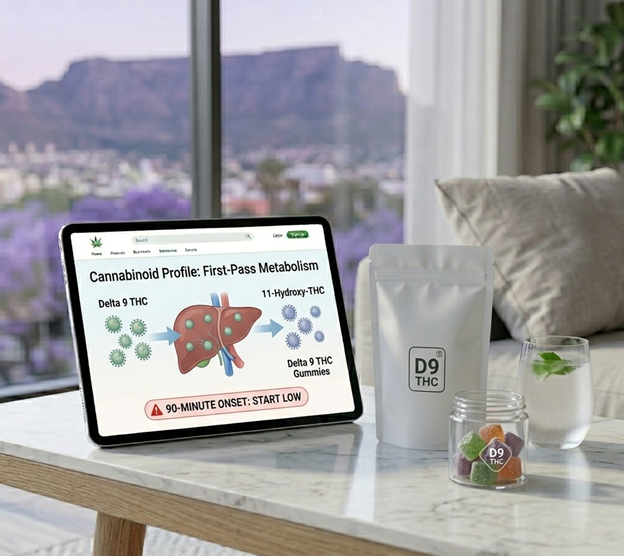
Understanding the potency of delta 9 thc gummies requires a look at human physiology. In 2026, consumer education focuses heavily on “First-Pass Metabolism.” When you ingest a Delta 9 gummy, the THC travels to the liver before entering the bloodstream.
During this process, the liver converts Delta-9-THC into 11-Hydroxy-THC. This metabolite is significantly more potent and has a much higher affinity for the CB1 receptors in the brain than inhaled THC. This is why a 10mg gummy can feel substantially stronger and last twice as long as a 10mg puff of flower. The 2026 “Start Low, Go Slow” protocol suggests waiting a full 90 minutes before considering a second dose to account for this metabolic conversion.
Safety Standards: COAs and Infusion Tech
In the 2026 market, the “Spray-On” method of the past—where cannabinoids were simply misted onto generic candy—is considered a major safety red flag. Premium delta 9 thc gummies now utilize “Homogeneous Infusion.”
The 2026 Gummy Quality Checklist:
- Infusion Consistency: Lab-verified gummies must show a potency variance of less than 5% across the entire batch, ensuring you don’t encounter a “hot spot” with unintended potency.
- Full-Panel COAs: A 2026 Certificate of Analysis must verify the absence of synthetic conversion chemicals. Since the new law excludes “chemically converted” cannabinoids, naturally extracted Delta 9 is the only federally compliant pathway forward.
- Child-Resistant Packaging: Compliant products are now required to use multi-stage locking mechanisms, moving away from simple jars to ensure these potent treats are inaccessible to minors.
Responsible Storage for Isomer Stability
To preserve the molecular integrity of your delta 9 thc gummies, storage conditions are vital. THC is susceptible to degradation from UV light and temperatures above 72°F (22°C). When exposed to heat, Delta 9 can degrade into CBN (Cannabinol), which is more sedative and lacks the euphoric properties of the original gummy. For maximum longevity in 2026, store your gummies in an airtight, opaque container in a cool, dark pantry to maintain the precise chemical profile verified by the manufacturer’s lab reports.


How Medical Marijuana Works And Why
Steps To Follow When Choosing Your Online Weed Seller
Why Buying Weed From An Online Dispensary In Canada Is Better Than Dealers
About Author
